“A human being is a part of the whole called by us universe, a part limited in time and space. He experiences himself, his thoughts and feelings as something separated from the rest, a kind of optical delusion of his consciousness. This delusion is kind of a prison for us, restricting us to our personal desires and to affection for a few persons nearest to us. Our task must be to free ourselves from this prison by widening our circle of compassion to embrace all living creatures and the whole of nature in its beauty.” --Albert Einstein
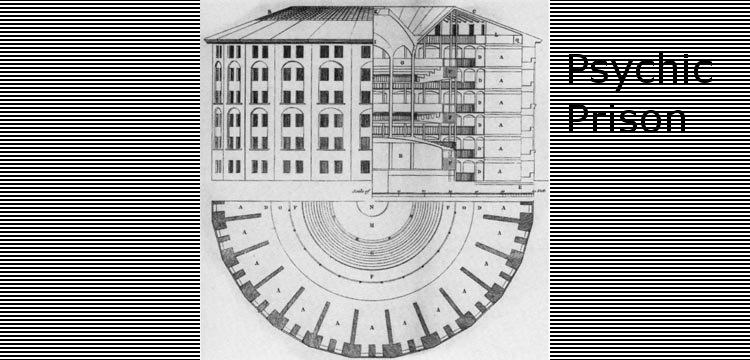
"I favor general use of the psychic-prison metaphor to free people from the traps of favored ways of thinking and to unleash their power and creativity."
--Gareth Morgan
"We cannot just remodel the prison. No, we've got to get out of it."
--W. Edwards DemingTuesday, July 02, 2013
An optical delusion


Saturday, February 12, 2011
The "false self" at work
"Only the true self can be creative and only the true self can feel real." -- D.W. Winnicott
"When we can take off our masks, we will see our brothers and sisters, whom we have mistakenly identified as the enemy." -- Danna Beal
The false self is a term that was introduced by Donald Winnicott.
That the false self can become a kind of psychic prison seems apparent enough. Other authors have written about this aspect of the false self, particularly in the context of work. Some of these quotes remain among the most poignant of any I've collected. In interviews with people who were dying the most common regret was: "I wish I'd had the courage to live a life true to myself, not the life others expected of me."
"When we can take off our masks, we will see our brothers and sisters, whom we have mistakenly identified as the enemy." -- Danna Beal
The false self is a term that was introduced by Donald Winnicott.
That the false self can become a kind of psychic prison seems apparent enough. Other authors have written about this aspect of the false self, particularly in the context of work. Some of these quotes remain among the most poignant of any I've collected. In interviews with people who were dying the most common regret was: "I wish I'd had the courage to live a life true to myself, not the life others expected of me."
Monday, November 29, 2010
"Bad apples"
Today I read a New York Times article that Psychologically Healthy Workplace Program had shared. I couldn't help but notice that this article's title on the NYT website was not the link's teaser, "How to Endure a Mean-Spirited Workplace," but rather: "How Bad Apples Infect the Tree" by Robert Sutton. I tend to agree with Lisa Takeuchi Cullen's reservations about Sutton's "No Asshole Rule", when she writes: "But something about Sutton's message hits a nerve. Maybe it's the epithet, which he defines helpfully as someone who persistently belittles and abuses those of inferior power or status. (As if we needed it spelled out.) Or maybe it's his argument that jerks exact a cost to the bottom line as they single-handedly corrode an organization's cohesion."
It's good to see Ms. Cullen--while not condoning atrocious behavior--defending her bosses from the eliminative impulse, even after she admits that "Sure, beastly bosses have shaved months off my life." But not to worry. My experience is that those who tend to be labeled as "bad apples" and subsequently eliminated from the workplace are much more likely to be those who at some point were seen as being a challenge to someone of higher rank, rather than those who in actuality might act abusively toward their subordinates. As Sutton's colleague Sam Culbert lectures (@3:22): "We live in an organizational culture where it's highly likely--and even probable--that subordinates get fired and the bosses get promoted."
Emily Bassman writes: "Abused employees are in a Catch-22 situation. Their harassers are in a position to control a variety of resources, which makes abused employees similar to other victims of abuse. But, unlike other victims, they have an added disadvantage. By virtue of their subordinate position, they automatically have less credibility than their superiors. Charging that they are being treated unfairly by their supervisors would challenge the context of the hierarchical system, which is a very threatening proposition to those who are in a position to help."
Then there's the notion of provocative victims, who are "frequently misperceived as bullies." More generally, fingers being pointed at someone as being akin to rotten fruit--such that "people around them wish they'd go away"--seems unlikely to bring out their best behavior. This isn't the first time we've come across the employee-as-spoiled-fruit metaphor. The author of the Employee Termination Guidebook, argues against attempting to "rehabilitate the problem employee," noting that "a bad apple remains a bad apple."
Given the organizational culture noted above, for Sutton to conclude that bosses themselves should look in the mirror is indeed a bold admonishment. Luckily, he's got tenure.
It's good to see Ms. Cullen--while not condoning atrocious behavior--defending her bosses from the eliminative impulse, even after she admits that "Sure, beastly bosses have shaved months off my life." But not to worry. My experience is that those who tend to be labeled as "bad apples" and subsequently eliminated from the workplace are much more likely to be those who at some point were seen as being a challenge to someone of higher rank, rather than those who in actuality might act abusively toward their subordinates. As Sutton's colleague Sam Culbert lectures (@3:22): "We live in an organizational culture where it's highly likely--and even probable--that subordinates get fired and the bosses get promoted."
Emily Bassman writes: "Abused employees are in a Catch-22 situation. Their harassers are in a position to control a variety of resources, which makes abused employees similar to other victims of abuse. But, unlike other victims, they have an added disadvantage. By virtue of their subordinate position, they automatically have less credibility than their superiors. Charging that they are being treated unfairly by their supervisors would challenge the context of the hierarchical system, which is a very threatening proposition to those who are in a position to help."
Then there's the notion of provocative victims, who are "frequently misperceived as bullies." More generally, fingers being pointed at someone as being akin to rotten fruit--such that "people around them wish they'd go away"--seems unlikely to bring out their best behavior. This isn't the first time we've come across the employee-as-spoiled-fruit metaphor. The author of the Employee Termination Guidebook, argues against attempting to "rehabilitate the problem employee," noting that "a bad apple remains a bad apple."
Given the organizational culture noted above, for Sutton to conclude that bosses themselves should look in the mirror is indeed a bold admonishment. Luckily, he's got tenure.
Friday, February 26, 2010
What was Toyota thinking?
In response to Congresswoman Speier's question about whether Toyota would offer installation of a brake override "chip" to any existing Toyota customer who requests one, Mr. Toyoda responds (@6:02):
"I do not know the technical details, but if it is technically and engineeringly possible, or if we can find a good method, we will do that, but other than that I do not know a good answer to that."
It seems like he should have already had an answer to such a question, as it's a question that should have been asked internally at Toyota, and been asked well before Congresswoman Speier asked it this week. I would've thought of Toyota leadership as being well-versed in brake override systems, particularly as 1) they still don't believe electronics could be an issue, 2) such a software upgrade would prevent sudden acceleration from any mechanical cause (pedal hooked on floor mat, bad pedal spring return, etc.), 3) U.S. auto manufacturers have already equipped their cars with such a brake override feature starting several years ago, 4) people have died in SA crashes, and it doesn't take a senior design engineer to figure out that such a system can save lives, and 5) a brake override system, as one auto industry analyst put it, is essentially no cost, as it's just a few lines of software code, and the software development cost when spread over an entire fleet of vehicles is negligible.
Makes me wonder, what was Toyota thinking? So, the congresswoman's call for Toyota to provide any company documentation related to the NHTSA visit to Japan seems a reasonable and pertinent one.
I'm quite impressed with Congresswoman Speier's line of questioning here, as I was with our other members of congress.
Thursday, October 29, 2009
Psychic Prison Quotes
Evans, P. 2003. Controlling People: How to Recognize, Understand, and Deal with People Who Try to Control You.
"Other people's definitions of us are not just absurd--if unchallenged, they erect prison walls around us. As they rise higher, the light of awareness fades. The world darkens. We lose freedom, safety, confidence, conviction, and sometimes ourselves." (p. 77)
Foucault, M. 1995. Discipline and punish : the birth of the prison.
"The practice of placing individuals under 'observation' is a natural extension of a justice imbued with disciplinary methods and examination procedures. Is it surprising that the cellular prison, with its regular chronologies, forced labour, its authorities of surveillance and registration, its experts in normality, who continue to multiply the functions of the judge, should have become the modern instrument of penalty? Is it surprising that the prisons resemble factories, schools, barracks, hospitals, which all resemble prisons?" (p. 227)
Morgan, G. 1986. Images of Organization.
As we examine the bureaucratic form of organization, therefore, we should be alert to the hidden meaning of close regulation and supervision of human activity, the relentless planning and scheduling of work, and the emphasis on productivity, rule following, discipline, duty, and obedience. The bureaucracy is a mechanistic form of organization, but an anal one too. And not surprisingly, we find that some people are able to work in this kind of organization more effectively than others. If bureaucracies are anal phenomena encouraging an anal style of life, then such organizations will probably operate most smoothly when employees fit the anal character type and can derive various hidden satisfactions from working in this context." (p. 209)
Morgan, G. 1998. Images of Organization: The Executive Edition.
"The groupthink phenomenon has been reproduced in thousands of decision-making situations in organizations of aIl kinds. It may seem overly dramatic to describe the phenomenon as reflecting a kind of psychic prison. Many people would prefer to describe it through the culture metaphor, seeing the pathologies described in all the above examples as the product of particular cultural beliefs and norms. But there is great merit in recognizing the prisonlike qualities of culture." (p. 186)
Zuboff, S. 1988. In the Age of the Smart Machine: The Future of Work and Power.
"Bentham's extensive plans for reform of prison management created both controversy and interest within the British Parliament. Though his management proposals were not implemented, the central principle of continuous observation made possible by technical arrangements was to influence the administrative and architectural orientation of bureaucratic organizations from schools, to hospitals, to workplaces in which individuals are taken up as unique problems to be managed and measured up against appropriate norms:
"Panopticism is the general principle of a new 'political anatomy' whose object and end are not the relations of sovereignty but the relations of discipline....What are required are mechanisms that analyze distributions, gaps, series, combinations, and which use instruments that render visible, record, differentiate and compare....It is polyvalent in its application....Whenever one is dealing with a multiplicity of individuals on whom a task or a particular form of behavior must be imposed, the panoptic schema may be used." (p. 322)
"Panopticism is the general principle of a new 'political anatomy' whose object and end are not the relations of sovereignty but the relations of discipline....What are required are mechanisms that analyze distributions, gaps, series, combinations, and which use instruments that render visible, record, differentiate and compare....It is polyvalent in its application....Whenever one is dealing with a multiplicity of individuals on whom a task or a particular form of behavior must be imposed, the panoptic schema may be used." (p. 322)
. 1995. Silent Sabotage: Rescuing Our Careers, Our Companies, and Our Lives from the Creeping Paralysis of Anger and Bitterness.
"At the organizational level, we must begin removing the hierarchical walls that we've built around us....We must move away from the concept that the boss is omnipotent and all powerful [sic] and move toward a more fluid organizational structure that favors a shared approach toward conducting business." (p. 57)
More quotes: psychic prison
More quotes: psychic prison
Wednesday, September 17, 2008
Healing the Workplace Culture
Danna Beal:
What I'm seeing in the workplace today is a web of egos that battle and compete for power. I see managers disempower employees. I see coworkers hurt and sabotage one another. This internal competiveness, this rivalry is based in fear. But, I believe that if we replace fear with trust and compassion, people everywhere can be restored to their true identities...
Wednesday, August 13, 2008
A lose-lose game
Advice from a former employment attorney:
"In the end, employment litigation is a lose-lose game. Plaintiffs I represented who received hundreds of thousands of dollars were usually broke within three years. And companies I sued didn't end up treating employees more fairly; they just made their employee handbook thicker. I truly believe the system causes more damage than benefit, and that's why I'm glad I have been out of it for the last 10 years."In regard to making the employee handbook thicker, William L. White writes:
"'The last act of a dying organization is a thicker rule book.' The need for rules to control staff members marks a dramatic change in mutual respect, loyalty, and the esprit de corps that characterized earlier stages of organizational life." [1]While David Whyte writes:
"Corporations, for their part, have been engaged in a willful battle against the very grain of existence. Like the good Dutch boy with his finger in the dike, they have spent enormous amounts of energy putting in place systems that attempt to hold back the shifting, oceanic qualities of existence. The complexity of the world could be accounted for, they fervently hoped, by a simple increase in the thickness of the company manual." [2]
Subscribe to:
Posts (Atom)